Adamas
Port · CentralThe harbour town and the natural base, with every restaurant on the island a 10–20 minute drive away. The waterfront is workmanlike rather than picturesque; you sleep here and eat elsewhere.
The geological outlier of the Cyclades — volcanic, mineral, almost-lunar. Sarakiniko at dawn, Kleftiko by small boat (book a week ahead), Klima's painted syrmata at the waterline. Base in Adamas or Pollonia, rent a car rather than an ATV. Three nights.
Last reviewed July 2026
Euros: cash for the tavernas. Come May–June, or September–early October; the ferry from Athens runs 3 hours fast, 4h30 slow. Budget €180–600 a day, doable at the low end. Base in Adamas or quieter Pollonia, book the boat day to Kleftiko (small boat only) and see Sarakiniko, just not at midday, and never with the big-boat tours.
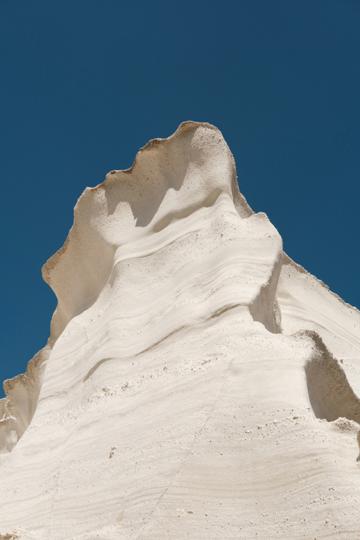
Milos is the geological outlier of the Cyclades: volcanic, mineral, almost-lunar in places. Sarakiniko is the white volcanic moonscape every drone-shot of Greece is secretly taken from. Kleftiko on the south coast is a system of sea-caves only reachable by small boat. Klima is a strip of candy-coloured fishermen's syrmata (boat garages) with the water lapping at their thresholds. The Venus de Milo was found here in 1820. The food is honest, the small hotels are excellent, and the island is small enough to do in three nights.
Base in Adamas (central port, every restaurant a 10–20 minute drive) or Pollonia (quieter, better boutiques). Rent a car, not an ATV; the bus doesn't reach the half of the island worth seeing. Book the Kleftiko boat a week ahead in season: it's the day you came for.
Three nights. Adamas base. Sarakiniko at 6 a.m.
Milos is quieter than Santorini or Mykonos by a wide margin: no cruise-ship terminal, no celebrity-villa scene. May, June, September are the windows when the boats run reliably and the beaches are uncrowded. August is hot (32°C+) and busy by Milos standards but still calmer than the headline islands. November through March, most hotels close and the Kleftiko boats don't run.
Adamas is the practical base and Pollonia is the quieter one; everything else you visit by day, by car for the inland villages, by small boat for the south coast.
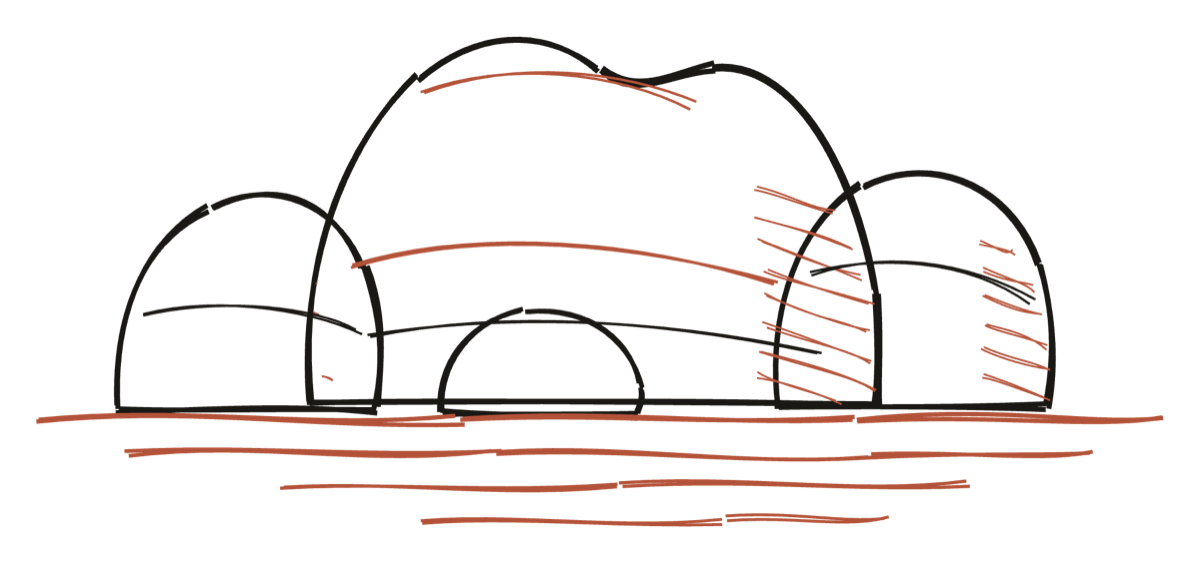
The harbour town and the natural base, with every restaurant on the island a 10–20 minute drive away. The waterfront is workmanlike rather than picturesque; you sleep here and eat elsewhere.
A two-street fishing village on the north tip with the island's best small boutiques, the Kimolos ferry, and Enalion, the kitchen that justifies crossing the island. The thinking traveler's base.
The Venetian hilltop capital and its village-twin. The Catacombs, the ancient theatre, the spot where the Venus de Milo was unearthed in 1820. Best at sunset, with one drink at Utopia.
The candy-coloured syrmata: fishermen's boat-garages with rooms above and doors at the waterline. Klima for the famous shot; Mandrakia for lunch at Medusa, on the rocks, without the crowds.
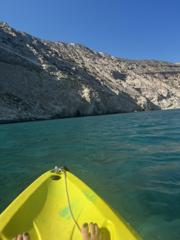
Only by small boat: the sea-caves of Kleftiko, the sulphur cliffs of Sykia, the coves the road can't reach. Book one full-day catamaran a week ahead, since this is the day you came for.
The lunar white-volcanic beach, bleached pumice and ash wind-smoothed into dunes of rock. Go at 6 a.m. or 7 p.m.; at midday in August it's a parking lot. Nearby: Mytakas, Firopotamos, Papafragas.
The table
Island cooking without much ceremony: caper leaves, pitarakia (cheese pies), grilled octopus, the local ladenia flatbread, sorted into three categories. Reserve Enalion, Medusa and Astakas a few days out in season.
The Milos taverna the whole internet has been telling you about, and for once the internet is right. On Papikinou beach, a 15-minute walk from Adamas; their own goats, their own cheese, hand-written menus on butcher paper. Get the pitarakia, the goat in lemon, the salad. No reservations after 8.
The fishing-village lunch in Mandrakia, at tables set on the rocks over the harbour. Order the grilled octopus and ask what came in that morning. Lunch only in shoulder season.
The Klima taverna set right on the water among the syrmata: fresh fish by the kilo and the namesake astakomakaronada (lobster pasta), at tables a metre from the bay, candlelit as the boat-houses turn gold. The island's romantic dinner, and it knows it.
The Pollonia waterfront classic: feet-in-sand tables, simple grilled fish, a lunch that keeps extending itself into the afternoon. Less precious than Astakas, and the one we'd pick on an ordinary day.
Adamas harbour stalwart, one of the oldest fish tavernas on the island. Mezze, fish, the local Milos cheese pies. Unfashionable on purpose; the menu hasn't changed and shouldn't.
The volcanic-sand oven taverna at Paleochori beach, where they bury the lamb, the fish and the gigantes in the geothermally-heated sand and cook them slow. Best at lunch, after the swim.
The kitchen you drive across the island for, and Milos is small enough that everyone does. Fresh-catch seafood handled with restraint at tables on the Pollonia waterline; the morning boats set the menu. Sea bass tartare, grilled shrimp, the fish soup people come back for. Book a week ahead in season.
The Adamas Italian-seafood crossover, up the first staircase from the port: lobster, pasta, a wine and cocktail list that goes deeper than it needs to. Casual by day, a sleek lounge after dark.
The garden taverna on the Tripiti hill, set around an old olive-press, with the long view down over the bay and Klima; book the sunset table. A wood-fired oven they claim is the only one on the island, and the position does the rest.
The cliff-edge sunset spot in Plaka: small, no reservations, packed by 7. Order one drink, sit on the wall, then walk down to dinner somewhere else. The drinking is the program here, not the eating.
The stay
Milos is a small-hotel island — no chains, very few +20-room properties. Three tiers. The best-designed picks are at the top; the practical mid-tier is the smart default for most travellers.
A small, family-run set of suites on the Pollonia waterfront, going since 2004, right by the harbour and a short walk from Enalion, Yialos and the rest of the village. The rooms are the cleanest and lightest in the price band, breakfast is in the courtyard, and the family at the desk knows the island cold. The reliable Pollonia base: well-run, central, not a destination in itself.
Ten white-on-white suites at the quiet Pelekouda tip of Pollonia, part of the Mr & Mrs White group: raw timber, aged-plaster walls, no hard corners. It sits on the calm, no-wind side of the peninsula, so the sun sets over the water directly off your balcony, where an à la carte breakfast is brought each morning. A short walk to Enalion and Yialos and the rest of the village; the best-value design base in Pollonia if Skinopi and the top tier are out of budget.
Cycladic minimalism with restraint: white-on-white, polished cement, pebble-shaped basins, the Pollonia bay in the window. Twelve adults-only suites on the Pollonia waterfront, eight with private plunge pools, built by three Greek-Australian women with Athens firm KKMK and now in the Michelin Guide. A Greek breakfast is brought to your terrace, facing the sea.
Six adults-only suites on the hill above Paliochori beach on the south coast, most with a private plunge pool and the wide view over the volcanic bay. There’s a small spa too (sauna, hammam, a treatment room), and the Sirocco sand-oven taverna is a walk down the hill. The choice if you want privacy and a pool day without full-resort prices.
A 23-room clifftop hotel above Pollonia, with the view running across to Kimolos, Sifnos and Poliaigos and a magnesium-mineral infinity pool as the centrepiece. White-and-blue-grey rooms, natural wood and raffia, breakfast made to order by the pool. It reads more "small resort" than "boutique," which makes it the design-tier pick for a family or a longer stay.
Seven stone villas above the bay, made of local stone and modelled on the syrmata, the fishermen's houses in the village just below. Each villa is named for a herb or tree that grows around it, and the place is deliberately stripped of the usual machinery: no spa, no restaurant, no buffet. Just the villa, the cove below it, and silence, ten minutes from Adamas.
The new-money entrant: 42 villas and suites built into their own cove at Agkali, with infinity pools, a beach club, two restaurants and the Obsidian spa. Reachable only through the hotel or by boat; the closest Milos has to a Mykonos-style luxury complex.
Rates are indicative high-season ranges; confirm current pricing when you book.
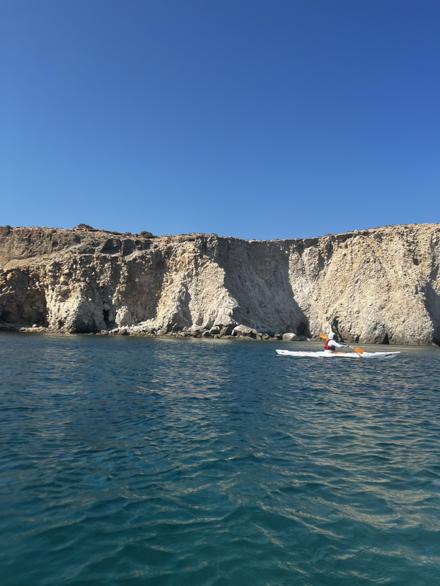
Most of the Milos coast only opens up from a boat.
Photography: Sofia ScarselliWhat to do
Twelve things in four categories, of which two are fixed: the boat day to Kleftiko, and Sarakiniko at dawn. The rest is geology, swims, and one long lunch in a fishing village.
North coast
The white volcanic moonscape. Go at 6 a.m. or 7 p.m.; the rock is white, there's zero shade, and at midday in August it's both punishing and crowded. Bring water shoes, because the rock is sharp.
South coast
The cult swim, reached by a near-vertical wooden ladder + rope down a fissure in the cliff. Small turquoise cove, no facilities, no service. If you're not steady, skip it; the drone shot isn't worth the ankle.
North coast
The photogenic fishing village plus a sheltered swimming bay. Quieter than Klima, easier than Tsigrado, with one decent taverna for after-swim lunch. Our pick when Sarakiniko is at capacity.
South coast
The big south-coast beach: geothermally-heated sand, three tavernas (Sirocco is the one), gigantes cooked in the sand itself. The half-day plan is a morning swim, a long lunch, and the drive home for a nap.
South coast
The day you build the trip around. A full-day catamaran or wooden-caïque tour around the south coast to the sea-caves at Kleftiko. Book a small boat (under 12 pax), not a big-boat tour; the caves are tight, and the day is intimate or it isn't. We send people to Polco Sailing: a 12-passenger catamaran out of Adamas, Kleftiko and the Sykia cave, lunch and the dinghy-into-the-caves bit included, ministry-licensed. From around €170 per person. Excellent Yachting and Thalassitra run good versions too.
South-west coast
Combined on most Kleftiko routes: a half-collapsed sea-cave you swim into, daylight pouring through the open roof, and the bright-yellow sulphur cliffs above it. Both are why you take the small boat, not the big one.
From Pollonia
The next-door island, a 30-minute ferry from Pollonia. Take the morning boat and head to Bonatsa (golden sand, calm shallow water, the Bonatsa taverna right behind it for a long lunch), then the late-afternoon ferry back. The whole day is the antidote to a hotel day.
West coast
The candy-coloured syrmata village. Park up top, walk down, sit on the sea wall as the light turns gold and the doors get lit. The photograph everyone takes, taken better at 7:15 in May than at 7:45 in August.
Plaka
The hilltop capital. Park outside the village (cars are punished inside), walk the white-laned spine to the Kastro, drink at Utopia as the sun goes down, walk back to the car. 90 minutes, end to end.
North coast
The smaller fishing-village twin to Klima. Eat at Medusa on the rocks, watch the boats come in. Nearby on the same north coast is Papafragas, a cliff-walled cove and sea caves that read like a natural swimming pool from above; the path down is steep and sometimes closed, so check before you commit, or just take it in from the top.
Tripiti
In Tripiti, the spot where the Venus was unearthed in 1820 (the statue is in the Louvre; the marker is here). The ancient theatre just below and the Venus site are free; the early-Christian Catacombs are a short guided visit. The whole circuit is an hour, best in the late afternoon when the light is low.
Adamas
Smaller than it sounds and better than you'd expect. Milos has been a mining island since the Neolithic, around 7,000 BC (obsidian first, then sulphur, bentonite, perlite, still shipped today), and the geology of the whole island lands once you've spent 40 minutes here. Pair with a wet day.
Milos isn't a beach island with interesting rocks. It's a volcano that stopped erupting and left the evidence lying around: a bleached-white moonscape, sea-caves you swim into, cliffs that run yellow with sulphur, a beach where the sand cooks your lunch. People have worked this ground since the Neolithic, around 7,000 BC: obsidian first, then sulphur, then the bentonite the island still ships today. And in 1820 a farmer turned up the Venus de Milo here; she's been in the Louvre ever since.
You don't really visit Milos. You read it — and the first thing to read is that the bay you sleep around is a drowned volcanic crater.
Read the islandBleached white pumice and ash, wind-smoothed into dunes of rock. This is the most photographed thing on the island, and it's solidified volcanic ash.
Dawn or 7 p.m.; zero shade, punishing and crowded at midday.
On the mapWhite volcanic rock the sea has carved into arches and caves you swim through. No road reaches it. The day you came for.
Small boat (under 12), booked a week ahead, not the big-boat tour.
On the mapA half-collapsed sea-cave you float into with daylight pouring through the open roof, while the cliffs above run bright yellow. That yellow is literal sulphur.
On the Kleftiko boat route; this is why you take the small boat.
On the mapA strip of candy-coloured syrmata, fishermen's boat-garages with the doors at the waterline, lit gold at dusk.
Sunset: 7:15 in May, not 7:45 in August. Park up top, walk down.
On the mapThe ground is still warm: the geothermal heat under Paleochori cooks the lamb and gigantes, buried in the sand in clay pots at Sirocco.
Midday swim, then the long lunch; the sand does the oven's work.
On the mapThe great bay isn't a bay. It's a flooded caldera, the drowned crater of the volcano. You sleep around its rim.
Your base — central, every beach 10–30 minutes out.
On the mapBelow the Plaka hill, beside the ancient theatre and the catacombs, a farmer dug up the Venus de Milo in 1820, cut from this volcanic island and gone to the Louvre.
Late afternoon, with a drink up in Plaka after.
On the mapBook the Kleftiko boat early. It sells out, and it is the one thing you'd regret missing. Lock it a week ahead, then build the rest around it. The whole geological loop sits inside the three-day plan.
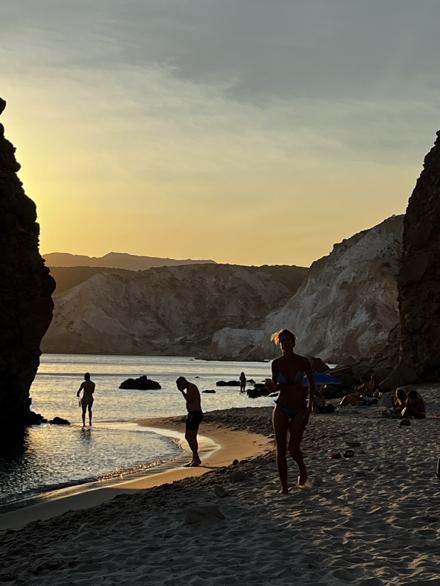
A cove on the south coast at the end of the day.
Photography: Sofia ScarselliBase in Pollonia or Adamas. Ease in on day one, give day two to the Kleftiko boat (the one you build the trip around), and spend day three on the inland villages and Sarakiniko at dawn.
Adamas port
Ferry from Athens, SeaJet in 3 hours or Blue Star in 4h30. Collect the rental car at the port, drive to the hotel, drop the bags.
Adamas harbour
The Adamas harbour stalwart: mezze, grilled fish, a glass of the white. An easy first meal, which is what a ferry day deserves.
North coast
The easy intro beach, a 20-minute drive to a sheltered bay. Water shoes on.
Plaka
Park outside, walk up, one drink on the wall as the sun goes down behind Sifnos.
Adamas
The goat, the pitarakia, the salad. Book or go before 8.
The boat day is long, so bring water, sunscreen, a towel, a hat and cash.
South coast
Polco, Thalassitra or Excellent Yachting, down the south coast: the Sykia sea-cave, the sulphur cliffs, the Kleftiko caves, three swim stops, lunch on board.
Shower and nap. Eight hours of sun on the water turns out to be a workout.
Pollonia
The splurge of the trip, booked a week out: sea bass tartare, the fish soup, whatever landed that morning.
North coast
The one alarm clock of the trip, and you'll be back at the hotel in time for breakfast.
The dawn shift is done and it isn't 9:30 yet. Then drive west.
Tripiti / Klima
The cultural circuit. Tripiti for the ancient sites, walk down to Klima for the photograph.
Mandrakia
Book ahead in season; octopus, fish, and no reason to hurry.
South coast
South coast, the geothermal sand, the lunch tavernas already covered above; here, just swim.
Klima
Astakomakaronada at candlelit tables among the syrmata; close out Milos here.
Eat like a Melian
A few things
The Kleftiko small-boat day is the spine of any Milos trip. In June–Sept the under-12-pax operators sell out a week ahead. Book it the moment your dates are set.
There is none at all. Go at 6–8 a.m. or 6–8 p.m. Midday in August is both punishing and the most crowded, the worst-of-both window most visitors hit by accident.
The roads to Plaka and the south-coast beaches are steep, narrow, and have one-lane stretches. The ATV looks fun in photos and is genuinely frightening in practice.
At O! Hamos!, Medusa, Sirocco and the family-run places, cash is preferred and sometimes cards simply won't work. Bring €200 in cash from Athens.
If you have any flexibility, sleep in Pollonia. The food is better, the harbour is prettier, the beaches are closer. Adamas is the practical port-side default.
Two nights is one beach day short and four nights has you repeating beaches. Three nights (boat day, dawn day, slow day) is the shape that fits Milos.
Tell us when you're going to Milos, for how long, and what kind of trip you want: geology-led, photography, honeymoon, a friend's group of six. We'll send a custom itinerary in 72 hours: hotels, restaurants, the Kleftiko boat operator, the inland-villages drive, the Sarakiniko dawn timing. two revision rounds included until it's right.
$85, one time.
Build my Milos tripDelivered in 72 hours · two revision rounds included

