Practical and opinionated, the stuff you'd ask a friend who lives up there. Read it all before you go.
On renting a car
Yes. Always.
The train ends at Bolzano or Brunico (Bruneck), and the valleys are 45–90 minutes past either. Buses connect the bigger valleys, but they're slow and they don't reach the trailheads. Pick the car up at Venice Marco Polo, Innsbruck, or Bolzano; Venice is the easiest international airport, the other two mean shorter drives. Skip the Italy-only collision insurance, since your credit card probably covers it already. Winter tyres or snow chains carried on board satisfy the requirement; the law says “ovvero abbiano a bordo”. In Trentino it runs 15 November–15 April on state and provincial roads outside built-up areas; in South Tyrol the fixed dates cover the A22 and Bolzano city, while on the mountain roads the obligation bites whenever there is snow or ice, year-round. On snow-covered lanes chains must actually be fitted.
On the three languages
South Tyrol is bilingual. Don't fight it.
The Alto Adige / South Tyrol half of the region runs in German first, Italian second; the Veneto half (Cortina, Auronzo) flips that. Ladin is the third language in the five Ladin valleys (Val Gardena, Alta Badia, Val di Fassa, Livinallongo, Cortina). Restaurant menus often come in three languages, village signs in two. Whoever you're talking to will switch to whichever you start in. English works almost everywhere, less so in the smallest farmhouses.
On lift passes
The Mobilcard is the unlock.
If your hotel is in South Tyrol (Val Gardena, Alta Badia, Alpe di Siusi, Val di Funes, Alta Pusteria), ask for the free DolomitiMobil or AlmencardPlus at check-in. They cover regional buses, trains, and most cable cars, and save €30–80 a day per person. The Cortina (Veneto) side doesn't include it, so you pay per lift. The Dolomiti Superski sells both a winter ski pass and a summer lift pass (Dolomiti Supersummer); prices and validity are on dolomitisuperski.com.
On hiking gear
Real boots. Not sneakers.
The trails are not paved paths. Even the easy ones cross loose rock, scree, and the odd patch of late-season snow. Mid-height ankle support, a lugged sole, broken in before the trip. A light layer system (base, fleece, shell), water, sun cream and sunglasses, because the altitude burns. Carry Tabacco maps (the paper ones, sold at any outdoor shop) for any hike beyond the lift-and-walk obvious ones. AllTrails handles routing but loses signal often.
On the Great Dolomites Road
110 km, all day, worth it.
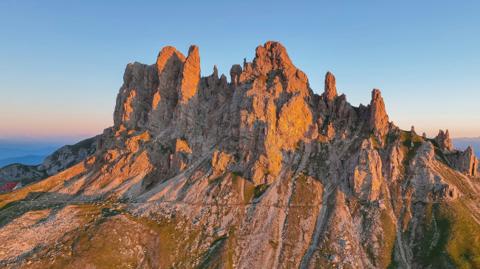
The original tourist road through the range, built in 1909: Bolzano through Karersee, over Passo Costalunga, past the Catinaccio massif, Canazei, Passo Pordoi, Falzarego, into Cortina. Four hours non-stop, all day once you start stopping for things. Coffee at Carezza, lunch at Canazei, a photo stop at the Pordoi cable car (2,950m), aperitivo at Lagazuoi sunset. Best in early October, when the larches turn yellow. Drive it if you're moving from west to east anyway.
On dinner times
7:30 p.m. is when most kitchens open, 8:30 is when you sit down, 9 is fine, 9:30 is pushing it in the Tyrolean half (the kitchens close early there). The Ladin and Cortina side is more flexible. Lunch reservations are essential at the named rifugios and anywhere with a Michelin star, even if you're just walking up. Most hotel half-board dinners run at a fixed time, so choose the later slot.
On the weather
Afternoon storms · plan around them.
June through August, the pattern holds: clear morning, building cumulus by noon, thunderstorms between 2 and 5 p.m., clear again by evening. Be off the high ridges (Seceda, Tre Cime, anything with cables) before 1 p.m. in summer. Mountain forecasts beat city ones, so use Meteo Trentino or the Dolomites Tourist Board app. Bring a shell jacket every day, even in August.
On bookings
Nine months out for summer.
That is the window for hotels. The top restaurants (SanBrite, Atelier Moessmer, La Stüa de Michil, Malga Panna) want three months, minimum.
On Lago di Braies
It's the lake. Pre-book the lot.
In summer the road to the lake is closed to cars without a pre-booked parking slot for part of the day. The dates and hours change each season and are published at pragsparking.com, so check there before you go. No exceptions, no on-the-day spots, no influencer loophole. Miss the booking window and the bus from Villabassa/Niederdorf is the alternative; current rules are at pragsparking.com. Or arrive outside the restricted hours, while the gate is still open and the lake is yours. The morning light is better anyway.
On cash
Card mostly. Cash at the huts.
Hotels, restaurants and shops take cards everywhere, though Amex is less reliable than Visa or Mastercard. Rifugio payment methods vary; carry cash as well as a card. Carry €60–100 in cash per hiking day to be safe. ATMs are in Cortina, Ortisei, San Cassiano and Corvara; you won't find one at a trailhead.
On the road etiquette
Stay calm. Locals always pass.
The mountain roads switchback hard, and the drivers who run them daily will pass you on blind corners; don't take it personally. Pull-outs (called piazzole di sosta) are scattered along the routes, so use them if a queue forms behind you. The Great Dolomites Road and the passes (Pordoi, Falzarego, Sella) are slow even in fast cars. Allow double the time Google Maps says, triple in summer.